

Aircraft use different voltage levels depending on the aircraft type, power requirements and application. 28 V DC is used in particular for many onboard devices and applications with lower power requirements, while 270 V DC and 115/200 V AC at 400 Hz are used for higher electrical power requirements. The choice of voltage system affects, among other things, the required current, cable weight, power distribution and the design of the electrical systems.
By combining different voltage levels, electrical systems in aviation can be designed according to their specific requirements and optimized in terms of weight, efficiency, safety and performance.
Why is 28 V DC used in aircraft?
28 V DC is an established voltage level in aviation and is used in particular in smaller aircraft, helicopters and for numerous onboard devices. It is suitable for applications such as lighting, avionics, as well as electrical systems and drives with lower to medium power requirements.
Compared with 12 V DC, as used for example in motor vehicles, 28 V DC results in a lower current at the same power level. This allows cable cross-sections and the weight of the electrical wiring to be reduced. 28 V DC was established early as an aircraft electrical system voltage, particularly in the military sector, and is also used today in civil aviation.
Aircraft batteries and battery-backed emergency power supplies are also operated at 24 V DC. Since batteries inherently provide direct current, the electrical energy can be used directly for appropriately designed DC systems. The relatively low voltage of 28 V DC also offers advantages in the design and handling of corresponding electrical systems. During maintenance and operation, the applicable safety regulations and protective measures must always be observed.
Key Facts 28 V DC
- Established aircraft voltage level for smaller aircraft, helicopters and numerous onboard devices
- Suitable for lower to medium power requirements
- Lower current at the same power level compared with 12 V DC
- Reduced cable cross-sections and lower wiring weight possible
- Compatible with the typical 24 V DC battery supply
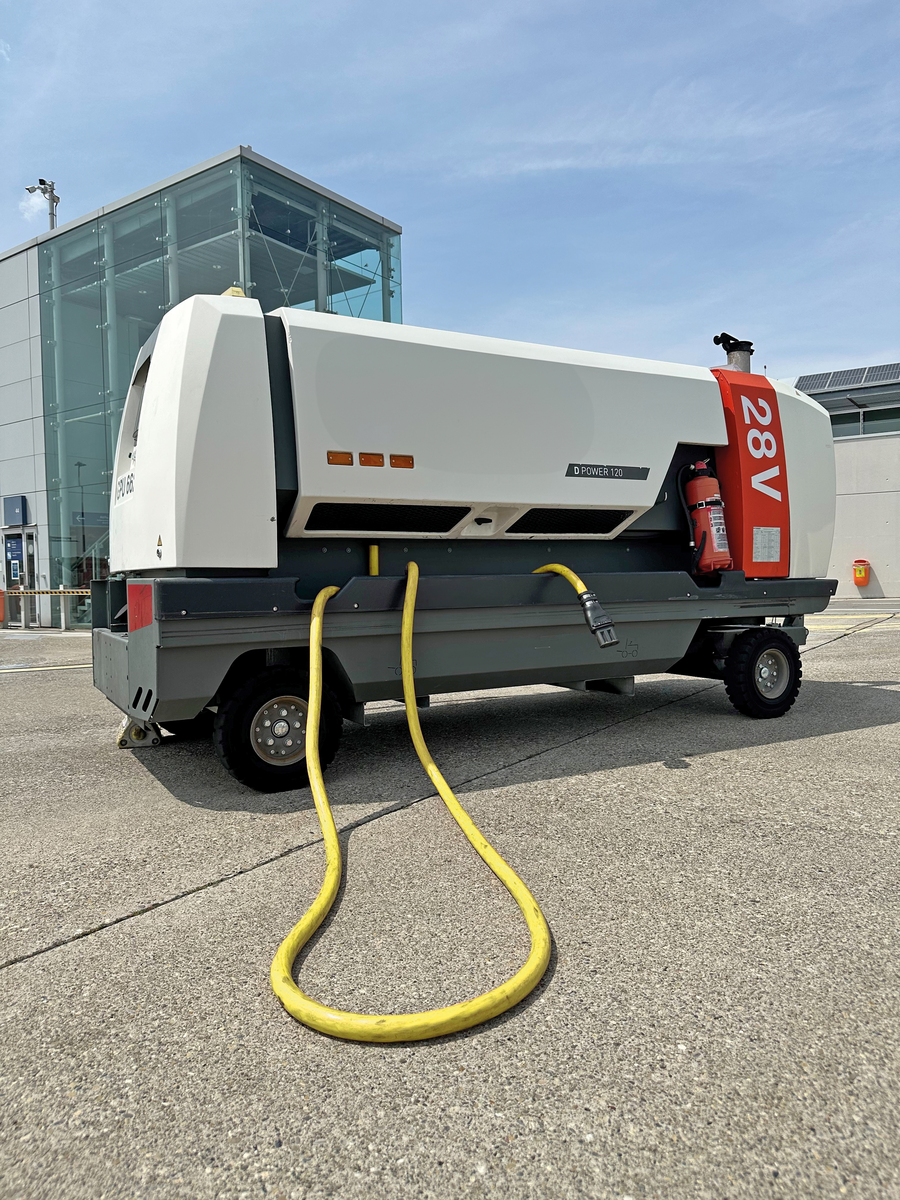
Why is 270 V DC used in aircraft?
270 V DC is used in particular in larger or highly electrified aircraft, where hydraulic and pneumatic systems are increasingly being replaced or supplemented by electrical systems. At the same power level, the higher voltage significantly reduces the required current. This allows smaller cable cross-sections and lighter cables. At the same time, heat losses in the cables can be reduced and efficient power transmission over longer distances within the aircraft can be supported. This is particularly relevant for high-performance aircraft.
Many high-power devices and electrical systems, such as actuators, electric drives for flight control systems or air conditioning systems, require appropriately designed electrical power supply systems. A 270 V DC system can be used in parallel with a 28 V DC aircraft electrical system. Appropriately designed high-power consumers can be supplied directly from the 270 V DC system, while devices operating on the 28 V DC system continue to be supplied via the corresponding voltage level. This allows different power requirements to be covered by appropriate voltage levels while reducing the weight and complexity of electrical power distribution.
Due to the significantly higher voltage, 270 V DC systems require special protective measures and compliance with applicable safety regulations during installation, maintenance and operation.
Our 270 V DC cables feature a robust PUR outer jacket that provides high mechanical strength and abrasion resistance, making them suitable for demanding applications in aviation. Learn more about our 270 V DC cables for aircraft ground power.
Key Facts 270 V DC
- Suitable for high-power applications and highly electrified aircraft
- Lower current at the same power level compared with 28 V DC
- Smaller cable cross-sections and lower cable weight possible
- Can be used in parallel with 28 V DC to cover different power requirements through appropriate voltage levels
- Special safety measures required due to the significantly higher voltage
The reasons for using 400 Hz and the advantages of this frequency compared with 50 and 60 Hz are explained in detail in our article “Why is a frequency of 400 Hz used in aircraft electrical systems?”
What are the advantages of 115/200 V AC at 400 Hz?
115/200 V AC at 400 Hz is used in aviation for higher power requirements, particularly in larger aircraft and for power-intensive electrical systems. The AC system enables the supply of numerous electrical consumers with higher power requirements and is an established standard for electrical power supply in aviation.
The 400 Hz frequency enables smaller and lighter magnetic components than the 50 or 60 Hz frequencies commonly used in public power grids. This can reduce the weight and size of corresponding electrical components, which is particularly important in aviation.
Key Facts 115/200 V AC (400 Hz)
- Suitable for higher power requirements in aviation
- Established standard for electrical power supply in larger aircraft and power-intensive systems
- High power and efficiency for electrical systems with corresponding power requirements
- 400 Hz enables smaller and lighter magnetic components than 50 or 60 Hz
- Suitable for numerous electrical consumers and systems in aviation
The different voltage levels require appropriately designed cables for aircraft ground power. Explore our range of 400 Hz, 28 V DC and 270 V DC cables for GPU and GSE applications.
What is the difference between DC and AC systems in aircraft?
Direct current and alternating current serve different purposes in aircraft and are used depending on the requirements of the respective electrical systems. Direct current (DC) is particularly suitable for onboard devices, avionics and systems that can be supplied directly from battery systems. Alternating current (AC) is used in particular for power-intensive electrical systems and enables the efficient supply of numerous consumers through the aircraft electrical system.
Direct Current (DC)
DC systems offer the advantage that electrical energy from battery systems can be used directly. This is particularly relevant for avionics, emergency power systems and other DC consumers. Different DC voltage levels, such as 28 V DC and 270 V DC, allow consumers with different power requirements to be supplied according to their specific needs.
Key Facts DC Systems
- For the stable and reliable operation of avionics and emergency power systems
- Direct use of battery power is possible because batteries inherently provide direct current
- Suitable for consumers that can be operated directly with direct current
- Lighter power supply and distribution components are possible with appropriately designed systems
- Different DC voltage levels enable consumers with different power requirements to be supplied according to their specific needs
Alternating Current (AC)
Alternating current is used in particular for power-intensive electrical systems. The 115/200 V AC system at 400 Hz is an established standard in aviation. The high frequency enables smaller and lighter magnetic components and therefore contributes to reducing the weight and size of electrical systems.
Key Facts AC Systems
- Suitable for power-intensive electrical systems
- 115/200 V AC at 400 Hz is an established standard in aviation
- 400 Hz enables smaller and lighter magnetic components
- Suitable for supplying numerous electrical consumers
Do you have questions about our cables?
Are you looking for the right cable for your application or would you like to learn more about our 400 Hz, 28 V DC and 270 V DC cables?
Our SAB team will be happy to support you in selecting and specifying the right solution for your application.
Contact the SAB team directly
Further information
General information on 28V DC / 270 V DC / 115/200 V AC
You can also find the most important technical information about the different voltage levels summarized in our PDF.